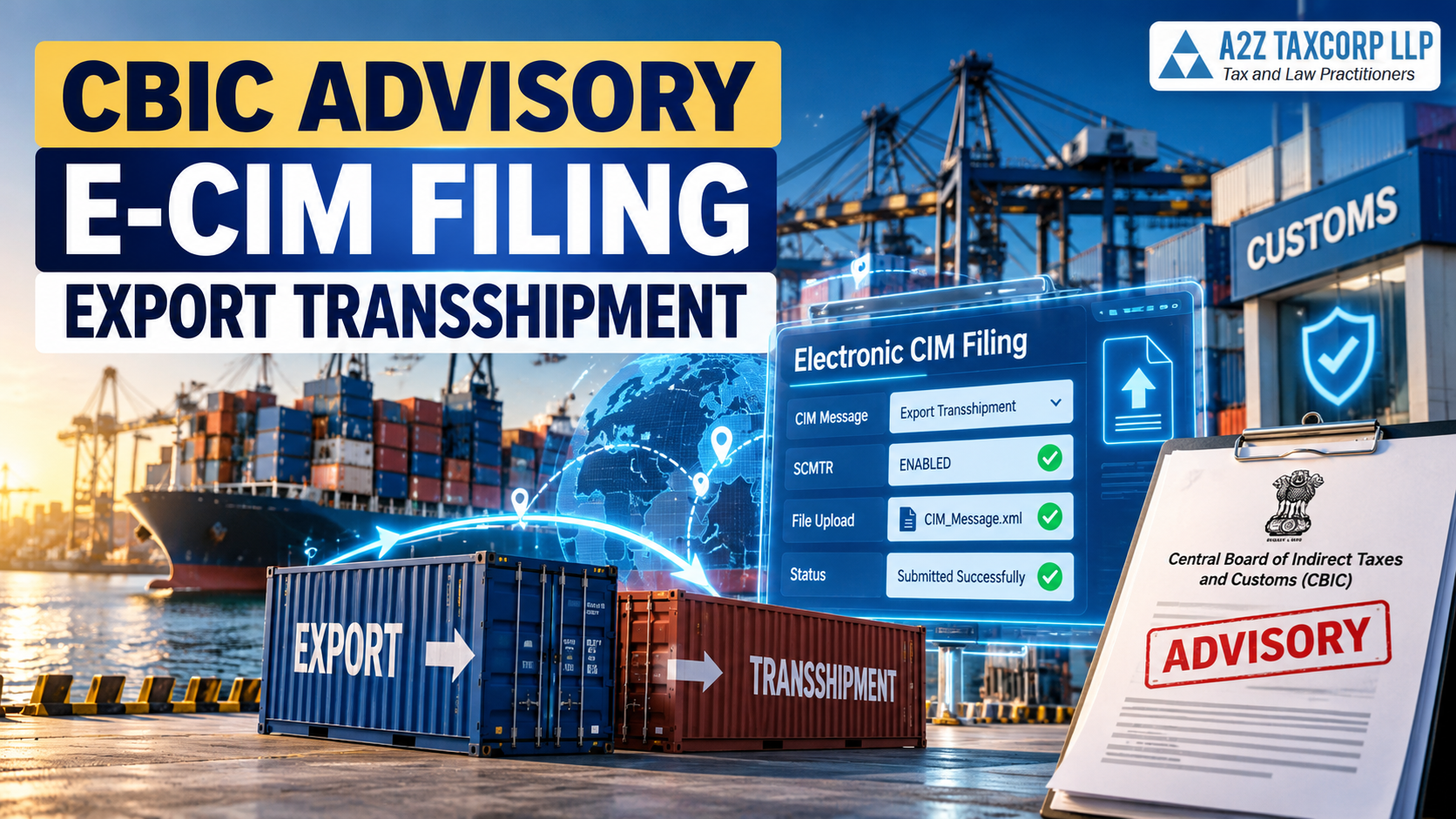
The Directorate General of Systems and Data Management (DG Systems), Central Board of Indirect Taxes and Customs (CBIC), has issued Advisory No. 41/2026 dated October 7, 2026, prescribing a structured electronic filing process for Customs Integrated Manifest (CIM) messages relating to Export Transshipment under the Sea Cargo Manifest and Transshipment Regulations (SCMTR).
The advisory explains the sequence of electronic messages, filing responsibilities of custodians and transhippers, system validations and mandatory acknowledgements to be followed for the movement of export cargo from Inland Container Depots (ICDs), Container Freight Stations (CFSs) and other inland Customs locations to gateway ports.
The initiative is aimed at strengthening electronic monitoring and traceability of export cargo movements through the ICEGATE platform.
Electronic Transshipment Reporting under Regulation 7 of SCMTR
As prescribed under Regulation 7 of the Sea Cargo Manifest and Transshipment Regulations, Form-VIII is required for import and export transshipment involving movement of goods between gateway ports and inland Customs locations.
Import transshipment involves the movement of cargo from a gateway port to an inland Customs location, whereas export transshipment involves movement from an inland Customs location to a gateway port.
To facilitate electronic reporting of export transshipment, DG Systems has enabled multiple CIM messages, including Stuffing Report (SF), Allowed for Shipment Request (ASR), Export Departure Message (DP), Departure Time Notification (DT), Arrival Message (AR) and Arrival Time Notification (AT).
The advisory specifies that the applicable messages must be submitted in the prescribed sequence, with successful system acknowledgements and required approvals before proceeding to subsequent stages.
Mandatory API-Based Filing through ICEGATE
Under Advisory No. 41/2026, all CIM messages must be filed electronically using the Application Programming Interface (API) utility available on the ICEGATE portal, after generation of the requisite API key.
Custodians and transhippers are required to use the prescribed message formats and specifications contained in the Custodian & Transhipper Message Filing Utility and the Message Implementation Guide (MIG).
The relevant utility and technical specifications are available for download through the official ICEGATE portal.
The advisory also requires Customs officers to ensure proper mapping of custodian codes with warehouse codes.
Such mapping must be unique, meaning that only one custodian code should correspond to a particular warehouse code. The mapping can be verified using the CUSADM role.
Shipping Bill Filing, Goods Registration and Let Export Order to Precede Electronic Transshipment
The electronic export transshipment process begins with filing of the Shipping Bill by the exporter or Customs Broker.
Thereafter, goods are registered at the concerned warehouse, ICD or CFS by the exporter, Customs Broker or authorised Shed Officer, as applicable.
The examination of goods and issuance of the Let Export Order (LEO) are undertaken by the Customs system or the Shed Officer, followed by container stuffing approval by the designated officer.
Only after completion of the requisite export clearance and stuffing-related formalities can the applicable CIM messages be filed.
Custodians Required to File Container-Wise Stuffing Report (SF)
The first principal electronic filing requirement is the Stuffing Report (SF), which must be submitted by the concerned Custodian (ACU) of the ICD or CFS.
After the Let Export Order and stuffing of export cargo, the custodian must submit container-wise stuffing details through the ICEGATE API.
The message must correctly identify the relevant container, Shipping Bill details, package particulars and applicable PCIN or MCIN references.
The Customs system validates the message and generates an acknowledgement (ACK), following which the designated officer grants container-wise stuffing approval.
No subsequent message should be filed until a positive acknowledgement and officer approval have been received for the SF message.
Stripping Report (ST) and Cancellation of Stuffing Report (SFCN)
Where an already stuffed container is opened for further examination or segregation of cargo, the custodian is required to file the Stripping Report (ST) electronically.
The ST message captures the relevant container-wise details of cargo stripped from the container.
The advisory also recognises the Cancellation of Stuffing Report (SFCN) message, which allows the custodian to cancel a previously filed stuffing report.
Following stripping and subsequent stuffing of the cargo, the applicable electronic filing sequence must be followed again to ensure that the Customs system reflects the revised cargo particulars.
These requirements are intended to preserve the accuracy of container-level cargo information throughout the export transshipment process.
Transhippers to File Allowed for Shipment Request (ASR) Shipping Bill-Wise
After successful filing and approval of the Stuffing Report, the relevant stuffing details are to be shared with the transhipper where the custodian and transhipper are different entities.
The Transhipper (ATP) must then submit the Allowed for Shipment Request (ASR) message on a Shipping Bill-wise basis.
The ASR message specifies the mode of transshipment and the next port of unloading.
The ICEGATE system validates the ASR details against the previously filed SF data and issues an acknowledgement.
The advisory expressly provides that the ASR message should be filed only after the SF message has been successfully acknowledged and approved.
Export Departure Message (DP) to Generate CIM Number and Date
Following a positive acknowledgement of the ASR message, the transhipper is required to file the Export Departure Message (DP).
The DP message captures the relevant departure particulars, including the vehicle number or train number through which export cargo is being transported.
Upon successful validation, the Customs system issues an acknowledgement containing the CIM Number and Date.
The transhipper must communicate the generated CIM particulars to the custodian for use in subsequent electronic filings.
This constitutes an important stage in establishing electronic tracking of the export transshipment movement.
Custodian to Report Actual Departure through DT Message
After receiving the CIM details from the transhipper, the custodian must submit the Departure Time Notification (DT) message.
The DT message records the actual departure time of the vehicle or train carrying export cargo from the originating inland Customs location.
The reported departure time is electronically linked to the relevant CIM number.
This requirement enables the Customs system to maintain an electronic record of the actual commencement of the cargo movement.
Arrival at Gateway Port to Be Reported through AR and AT Messages
Upon arrival of the export cargo at the next unloading station or gateway port, the transhipper must submit the Arrival Message (AR).
The AR message confirms that the relevant container has entered the terminal gate at the next unloading station.
After approval of the AR message, the system issues the necessary acknowledgement.
Subsequently, the Terminal Operator (ATO) submits the Arrival Time Notification (AT), reporting the actual arrival time at the destination port.
The AT message records the arrival against the applicable CIM details, completing the prescribed electronic reporting sequence for the movement.
Mandatory Sequential Filing and System Acknowledgements
Advisory No. 41/2026 emphasises that electronic messages must be filed in the prescribed order and that subsequent messages should not be submitted without the required acknowledgement or approval of the preceding message.
The principal export transshipment message sequence is:
SF → ASR → DP → DT → AR → AT
The advisory specifically requires that:
- The SF message must receive a positive acknowledgement and officer approval before ASR filing.
- All relevant containers must receive stuffing approval where a Shipping Bill covers multiple containers.
- The ASR must be successfully acknowledged before DP filing.
- The CIM Number and Date generated through the DP acknowledgement must be recorded and used in subsequent filings.
- Errors identified during validation must be rectified before the relevant message is re-filed.
The process flow chart annexed to the advisory further illustrates the responsibilities of exporters, Customs officers, custodians, transhippers and terminal operators at each stage.
Container-Wise Package Details Must Match Shipping Bill Information
DG Systems has specifically instructed stakeholders to ensure strict consistency between the container-wise Stuffing Report and the corresponding Shipping Bill.
Where a Shipping Bill covers multiple containers, separate SF messages must correctly allocate the relevant packages to each container.
For example, where a Shipping Bill covers ten packages loaded into two containers, the package allocation may identify Packages 1 to 5 in the first container and Packages 6 to 10 in the second container.
The advisory requires all container numbers, package numbers and package details to be verified before submission of the SF message.
Any mismatch may result in system validation errors and delays in subsequent transshipment processing.
Defined Responsibilities for Customs Stakeholders
The advisory establishes a clear division of responsibilities among the stakeholders involved in export transshipment.
Exporters and Customs Brokers are responsible for Shipping Bill filing and applicable goods registration formalities.
Customs officers or the system undertake examination and Let Export Order processing, while the designated officer provides container stuffing approval.
Custodians are responsible for container-wise stuffing and stripping-related filings and departure time notifications.
Transhippers are responsible for filing ASR and DP messages, obtaining CIM particulars and reporting arrival at the next unloading station.
Terminal operators are responsible for reporting actual arrival time through the AT message.
This role-based filing framework is intended to ensure greater accountability and consistency in electronic cargo movement records.
Greater Transparency and End-to-End Tracking of Export Cargo
The prescribed filing mechanism supports electronic recording of important cargo movement events, including stuffing approval, shipment authorisation, departure particulars, actual departure time, arrival confirmation and actual arrival time.
The process is expected to improve data accuracy, coordination among Customs stakeholders and visibility of export transshipment movements between inland Customs locations and gateway ports.
The emphasis on mandatory acknowledgements and verification of Shipping Bill details is also intended to reduce mismatches and facilitate smoother processing of export cargo.
Exporters, Custodians and Transhippers Advised to Ensure Technical Readiness
The advisory has important operational implications for exporters, Customs Brokers, ICDs, CFSs, custodians, transhippers and gateway port terminal operators.
Affected stakeholders should verify the applicable registration and custodian-warehouse mapping requirements, ensure availability of ICEGATE API access, implement the prescribed CIM message formats and establish internal checks for acknowledgement monitoring.
They should also ensure that container-wise stuffing records accurately match Shipping Bill particulars and that the generated CIM information is consistently used throughout the export movement process.
The key compliance requirement under Advisory No. 41/2026 is that export transshipment movements must be electronically reported through the prescribed CIM messages, with each filing dependent upon successful validation and acknowledgement of the preceding stage, together with applicable officer approvals.
The Advisory can be accessed at: https://a2ztaxcorp.net/wp-content/uploads/2026/10/Advisory-41-2026-CIM-Message-filing-process-for-Export-Transhipment.pdf
![[Good News] RoDTEP Scheme for SEZ/EoU/AA exports has been extended untill January 14, 2025](https://i0.wp.com/a2ztaxcorp.net/wp-content/uploads/2025/01/RoDTEP-Scheme-for-SEZEoUAA-exports-has-been-extended-untill-January-14-2025.png?fit=1024%2C473&ssl=1)