The government has not undertaken any assessment of the revenue and inflationary implications of Goods and Services Tax (GST) rate rationalisation, the Lok Sabha was informed on Monday. In a written reply to a question, Minister of State for Finance Pankaj Chaudhary stated that no formal study on the inflationary implications of GST rate rationalisation has been conducted. He also said that while a specific study regarding the fiscal impact, consumption patterns and sectoral growth following rate rationalisation has not been conducted, the reduction in GST rates is expected to provide direct and indirect relief to common people and investors by lowering the tax burden on essential goods and services, thereby improving affordability, reducing the cost of living, and supporting household consumption.
As per the latest data available, gross GST revenue collections have recorded a growth of 8.1 per cent in February 2026 as compared to February 2025.
The rationalisation of rates is also expected to reduce transaction costs, ease compliance, encourage greater formalisation, and widen the tax base. Sector-specific rate reductions are expected to support competitiveness and investment by lowering costs in construction, boosting demand in automobiles, improving access to life-saving drugs and medical devices, and promoting labour-intensive MSMEs such as toys, handicrafts, and man-made fibres.
Recent trends in high-frequency indicators, including higher e-way bill generation, improved Purchasing Managers’ Index (PMI) readings for manufacturing and services, record festive-season automobile sales, robust UPI transactions, and increased tractor sales, indicate a strengthening economic momentum during September–December 2025, following the implementation of GST reforms.
Furthermore, as per the NABARD Rural Economic Conditions and Sentiments Survey (November 2025), 79.2 per cent of rural households reported increased consumption expenditure in the last one year, the highest among all bi-monthly rounds in FY2025–26 so far. The reply did not provide details of changes made in the GST rate structure and the goods and services affected thereby.
On steps taken by the government to ensure revenue neutrality and fiscal stability of the states after revisions in GST rates, the minister said GST rates and exemptions are prescribed based on the recommendations of the GST Council, which is a constitutional body comprising representatives of the Centre and the states.
All states have enacted their Fiscal Responsibility and Budget Management (FRBM) Act. Compliance with the state FRBM Act is monitored by the respective state legislatures. The Central government usually considers the fiscal limits as per the accepted recommendations of the Finance Commission while exercising powers to approve borrowings by states under Article 293(3) of the Constitution of India.
The minister added that the government proposes to undertake periodic review of the GST rate structure to balance revenue requirements and consumer welfare through the GST Council mechanism.
|
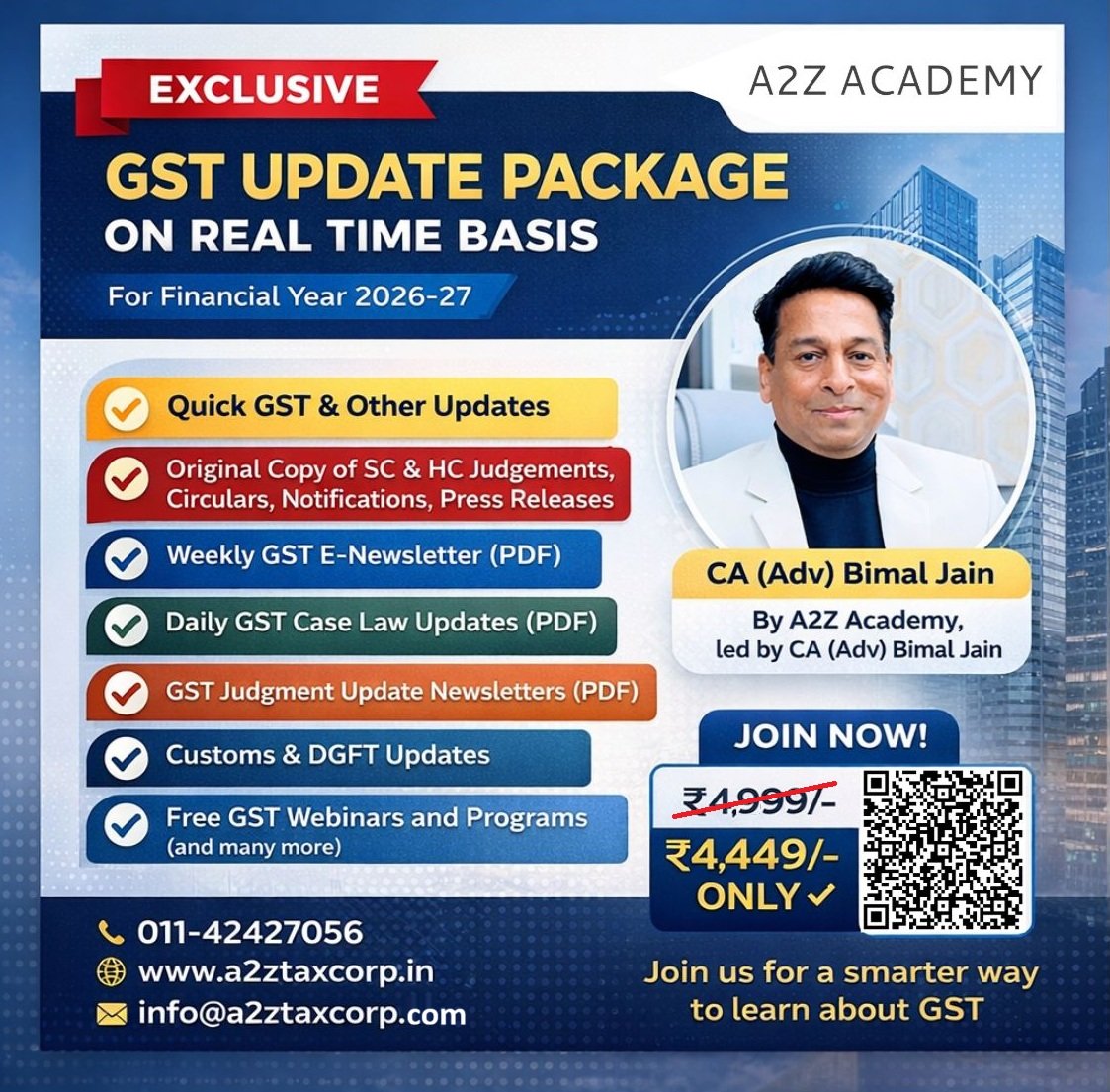
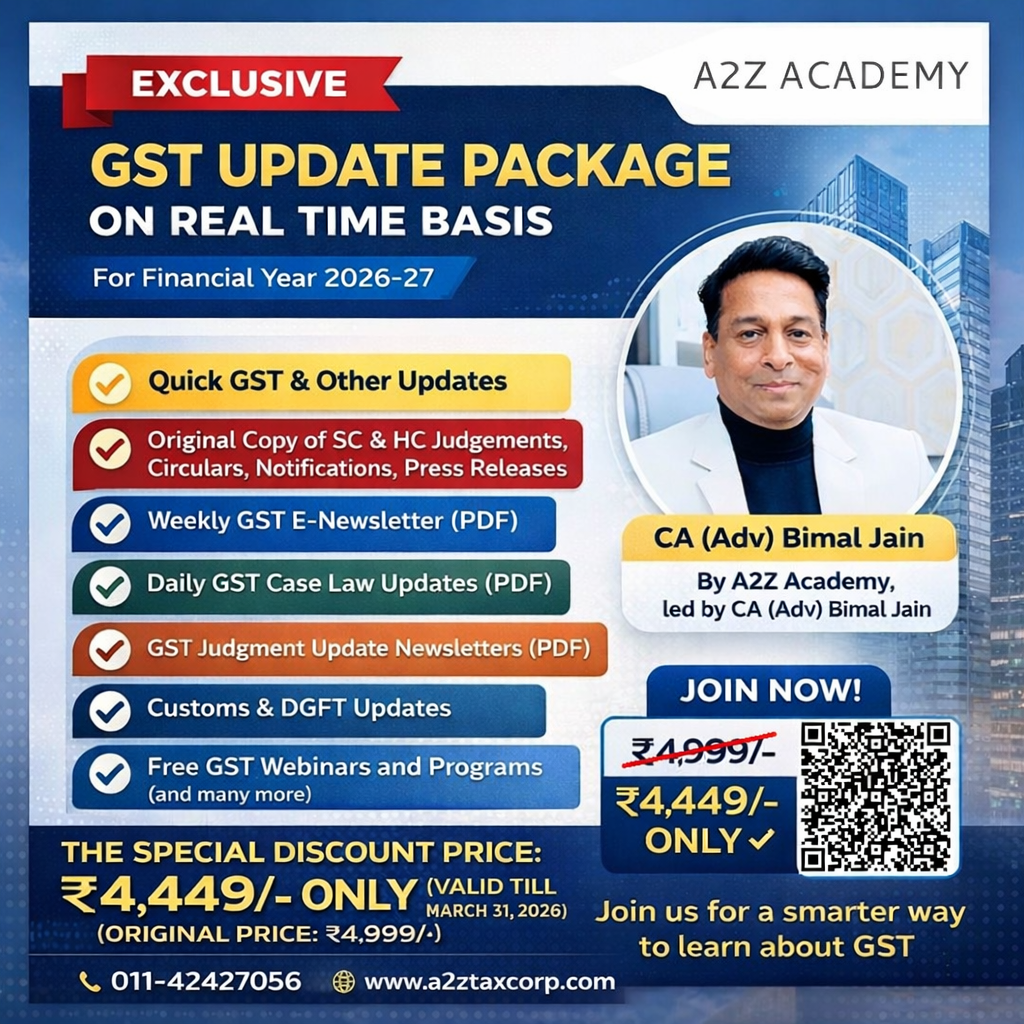
THE SPECIAL DISCOUNT PRICE VALID TILL MARCH 31, 2026 – RENEW NOW: EXCLUSIVE GST UPDATE PACKAGE FOR FY 2026–27 By A2Z Academy | Led by CA (Adv) Bimal Jain
🚀 EXCLUSIVE GST UPDATE PACKAGE — REAL-TIME UPDATES FOR FY 2026–27 By A2Z Academy | Led by CA (Adv) Bimal Jain 🔥 Special Price: ₹4,449/- only (Till March 31, 2026) (Original Price: ₹4,999/-) ✨ Why Join This Package?
📌 Validity: April 01, 2026 – March 31, 2027 📌 No Login Required — Seamless updates throughout the financial year 📞 011-42427056 🌐 www.a2ztaxcorp.in 📧 info@a2ztaxcorp.com Stay Updated: Know Every GST change with our comprehensive, real-time update package designed for professionals, corporates, and Tax practitioners. |